
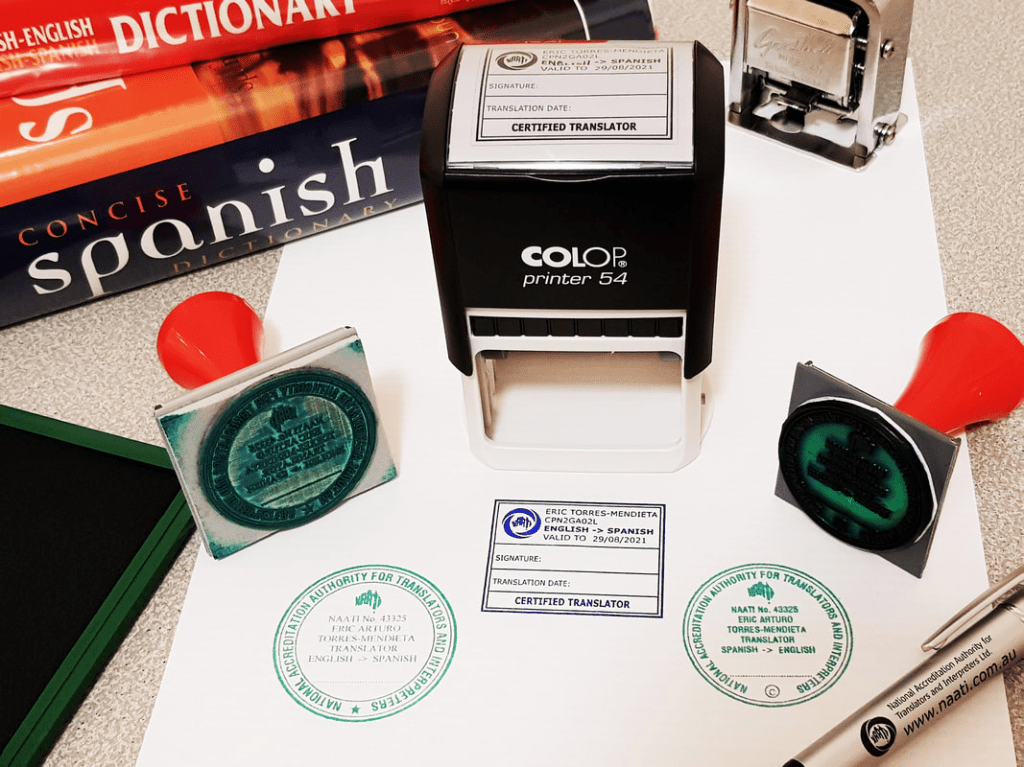
In most cases, when referring to a “NAATI-certified translation,” it usually means a translation document provided by a NAATI Level 3 Certified Translator (Certified Translator). NAATI-certified translations are widely recognised by government departments, legal institutions, educational institutions, and medical organisations in Australia and New Zealand, and are typically used for visa applications, immigration, qualification assessments, legal matters, etc.
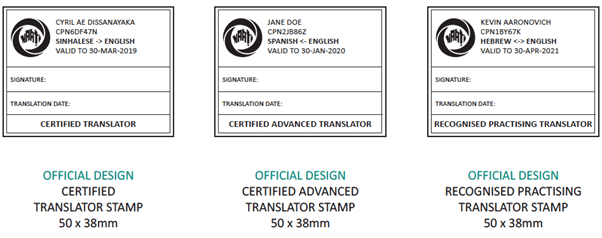
Rectangular NAATI Certification Stamp
The rectangular NAATI Certification Stamp (i.e. the ink stamp) is currently the most recognised NAATI certification stamp in the industry. All NAATI-certified translators holding this type of stamp are part of NAATI’s Recertification system. Consequently, the details of these translators can be verified via the NAATI Official Translator Directory: NAATI Certified Translator Directory.
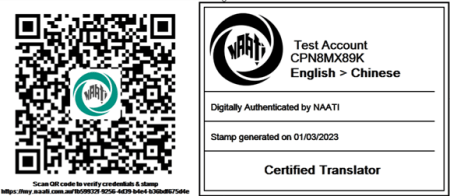
Moreover, only those translators who meet the recertification requirements are eligible to use the newly introduced Digital Stamp from NAATI, which includes a QR code for online verification of the translation document’s authenticity.
How to Distinguish Between the Old NAATI Accreditation and the New NAATI Certification?
Currently, there is considerable confusion online regarding the use of NAATI Accreditation (the old system) versus NAATI Certification (the current system), which can lead to misunderstandings for clients.
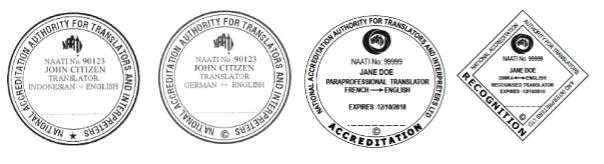
1️⃣ Old NAATI Accreditation (Discontinued)
- Identifier: The translation stamps are mostly round (ink stamps only).
- Status: This was the NAATI accreditation system before 2018. Since the reform in 2018, NAATI no longer promotes this system; however, translators holding this qualification may continue to use their old credentials.
- Issue: Since these translators are not part of NAATI’s current “Recertification” system, they cannot use the new rectangular NAATI Certification Stamp or the NAATI Digital Stamp.
- Recognition: Many government agencies no longer accept translations provided by translators under the NAATI Accreditation system. For example, the Department of Foreign Affairs and Trade (DFAT) has officially stated that only translations by translators within the NAATI Certification system will be accepted: DFAT Official Translation Requirements.
2️⃣ Current NAATI Certification (Introduced in 2018)
- Identifier: The translation stamp is rectangular (available as both an ink stamp and a digital stamp).
- Status: This is the only certification system currently promoted by NAATI. All qualified translators must be part of NAATI’s “Recertification” system and regularly update their qualifications.
- Advantages: Possession of the NAATI rectangular stamp allows verification through the NAATI Official Translator Directory: NAATI Certified Translator Directory.
- Recognition: Translations issued by translators under the current NAATI Certification system are widely accepted by major Australian government agencies, such as the Department of Home Affairs (DHA), DFAT, courts, universities, banks, etc.
⚠️ Important Reminder: How to Avoid Choosing the Wrong Translator
✅ Choose a translator who holds a “Rectangular NAATI Certification Stamp” or “NAATI Digital Stamp”.
✅ Verify the translator’s credentials via the NAATI Official Website: NAATI Certified Translator Directory.
✅ Beware of fraudulent translators. If the QR code on the NAATI Digital Stamp does not match the translator’s information, it is highly likely to be an illegal translation.
📢 Conclusion: If your documents need to be submitted to government or official institutions, be sure to choose a translator from the NAATI Certification system to ensure the validity and legality of the translation documents!
You May Also Like




 BL Translations