

The reason for deliberately discussing the validity period for NAATI-certified translations separately is that this issue needs to be addressed according to the different types of documents.
NAATI-certified translation validity varies depending on the document type and its usage, and can be broadly divided into two categories: Permanent Documents and Temporary Documents. Understanding this is crucial when applying for visas, immigration, notarisation, and other official purposes.
1. Permanent Documents (Long-Term Valid)
Permanent documents typically refer to those that do not change over time, such as:
- Birth Certificates
- Educational Certificates and Degree Certificates
- Marriage Certificates
- Divorce Decrees
Translations of these documents usually have no time limit; once NAATI-certified, they can be used indefinitely. When applying for visas, citizenship, or qualification assessments, government agencies typically do not require re-translation as long as a NAATI-certified translation is provided.
However, although the translation itself is valid for the long term, different institutions (e.g., some professional accreditation bodies) may require that the translation’s signing date is not earlier than a certain date. Therefore, it is advisable to confirm with the relevant institution before engaging a NAATI translator.
2. Temporary Documents (Valid for a Limited Time)
Certain documents or certificates are inherently time-sensitive, and thus the validity of their translations is also limited. Common examples include:
- Police Clearance Certificates (usually valid for 3–12 months, depending on the specific purpose)
- Bank Deposit Certificates (usually valid for 1–3 months)
- Proof of Identity Documents (such as household registration, driver licences, etc.)
- Proof of Income and Employment Certificates
- Health Certificates and Medical Reports
- Visa Approvals or Immigration-Related Correspondence
- Company Registration Documents (e.g. Business Registration Certificates)
These translations are typically valid for a certain period after NAATI certification. Once that period expires, the relevant institution may require updated original documents and new translations. Therefore, it is important to confirm the validity period with the relevant department before submitting these documents.
3. Factors Affecting the Validity Period of NAATI-Certified Translations
In addition to the document type, the regulations of different institutions may also affect the applicability of NAATI-certified translations, including:
- Government Departments (e.g. the Australian Immigration Department): Some documents have specific validity requirements. For instance, a translation of a police clearance certificate for a visa application may need to have been completed within the last 6 months.
- Educational Institutions: During qualification assessments and degree evaluations, institutions may require that documents have been translated recently, especially when applying for study or professional assessments.
- Banks and Financial Institutions: For financial documents (such as deposit certificates and bank statements), translations may only be accepted if completed within the last 3 months.
- Employers and Professional Accreditation Bodies: In employment assessments or job applications, recent translations may be required to ensure that the information is up to date.
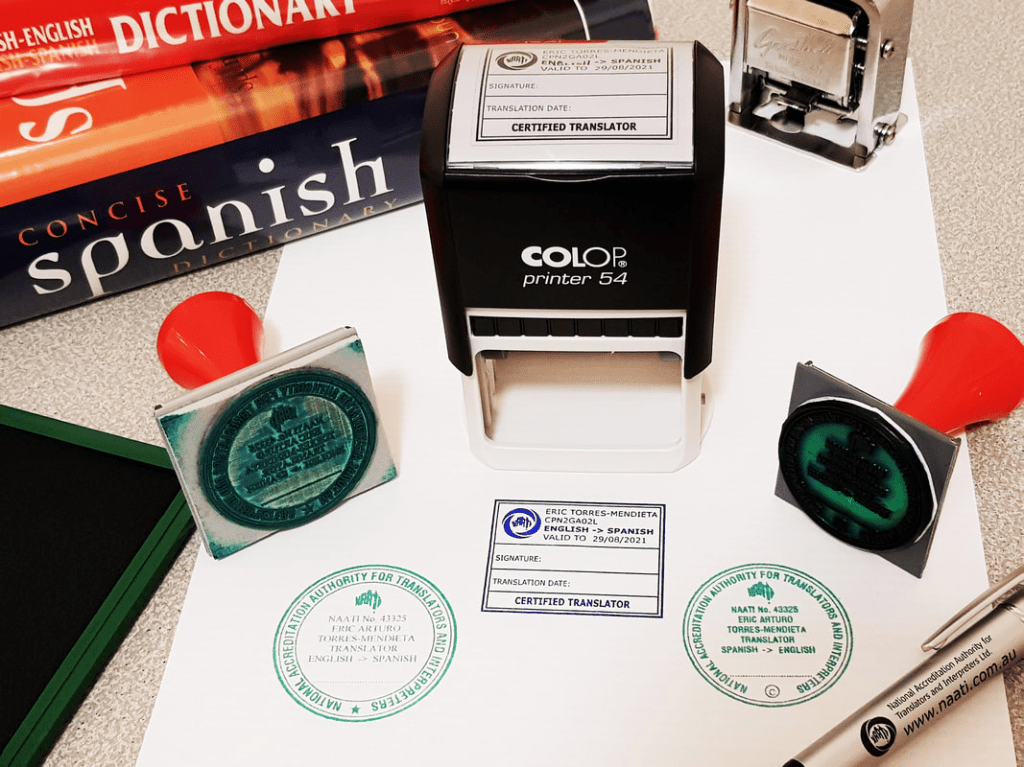
In addition, the validity of a NAATI-certified translation is not only determined by the document type but is also affected by the validity of the translator’s NAATI certification stamp. Whether for permanent or temporary documents, the translation’s signing date must fall within the validity period of the translator’s NAATI certification stamp, or it may not be accepted.
For example, if a translator’s NAATI certification is valid until 1 April 2025, then the final signing date of all translations must be before 1 April 2025 to be considered valid. Even if the document itself is permanent (such as a birth certificate or educational certificate), if the translation’s date does not fall within the valid period of the certification stamp, the relevant institution may deem your translation invalid or unusable.
Therefore, when using NAATI-certified translations, it is recommended to verify that the translator’s certification stamp is current, especially when submitting documents for immigration, visa, qualification assessments, or legal matters, to ensure the legality and validity of the translation.
You May Also Like
What is a NAATI-Certified Translation? What are the Differences Between the Stamps?
4. Conclusion
🔹 Permanent Documents (such as birth certificates and educational certificates) generally have no time restrictions and can be used indefinitely.
🔹 Temporary Documents (such as police clearance certificates and bank deposit certificates) are subject to time limits due to the inherent validity period of the documents.
🔹 When using NAATI-certified translations, always confirm the specific requirements of the relevant institutions in advance to avoid delays in your application process due to expired documents.




 BL Translations