

Languages Spoken by Recent Popes & the Decline of Latin in the Vatican
Over the past century, popes have evolved from Latin-speaking theologians to multilingual global leaders. Here’s a look at the languages spoken by the popes from the 20th century onward, grouped by language families, and an exploration of why Latin has declined in papal usage.
Languages, like global powers, constantly shift. They’re living systems — adaptive, selective, self-regulating. Like any system, language: Simplifies over time, Optimises for practicality, Drops what’s unused, Reflects shared memory, Evolves with social needs – Even the Vatican isn’t exempt.
🌍 Language Families of Popes (1903–Present)
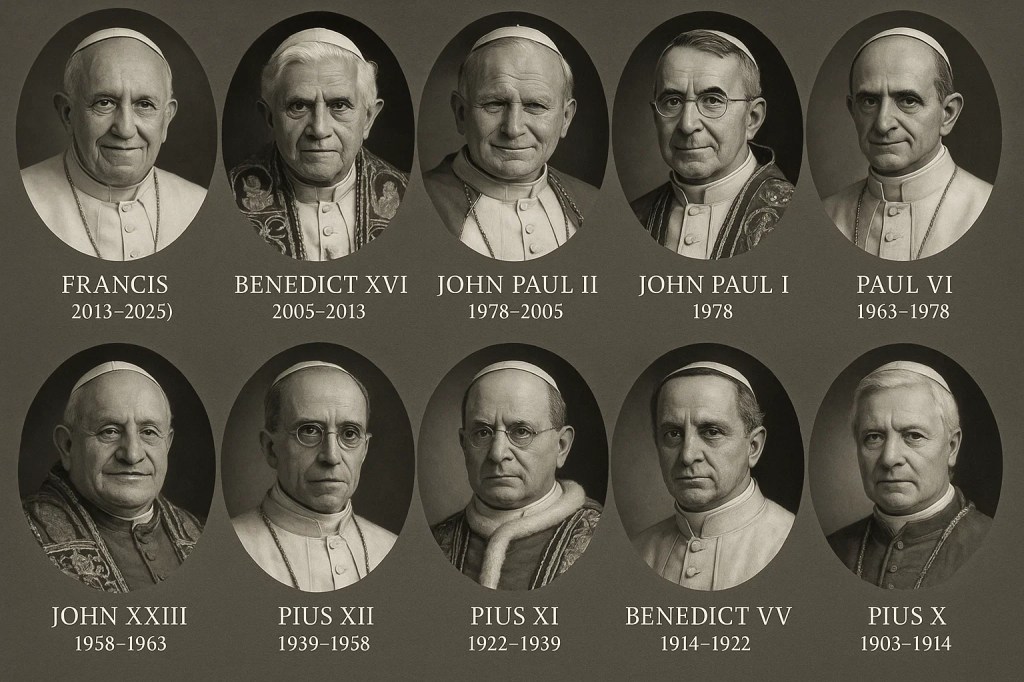
| Pope | Native Language | Other Languages Spoken | Language Families |
|---|---|---|---|
| LEO XIV (2025 – ) | English (US) | Spanish, Italian, French, Portuguese, Latin and German. | Romance: Spanish, Italian, French, Portuguese, Latin Germanic: English, German |
| Francis (2013–2025) | Spanish (Rioplatense) | Italian, German, French, English, Portuguese, some Ukrainian, Latin (limited) | Romance: Spanish, Italian, French, Portuguese, Latin Germanic: English, German Slavic: Ukrainian |
| Benedict XVI (2005–2013) | German | Latin (fluent), Italian, French, English, Spanish, Portuguese, some Greek, Hebrew | Germanic: German, English Romance: Italian, French, Spanish, Portuguese, Latin Hellenic: Greek Afro-Asiatic: Hebrew |
| John Paul II (1978–2005) | Polish | Latin (fluent), Italian, French, German, English, Spanish, Slovak, Russian | Slavic: Polish, Slovak, Russian Romance: Italian, French, Spanish, Latin Germanic: German, English |
| John Paul I (1978) | Italian | Latin, French, German, English, Spanish | Romance: Italian, French, Spanish, Latin Germanic: English, German |
| Paul VI (1963–1978) | Italian | Latin (fluent), French, English, German | Romance: Italian, French, Latin Germanic: English, German |
| John XXIII (1958–1963) | Italian | Latin (fluent), French, German, Greek, Turkish | Romance: Italian, French, Latin Germanic: German Hellenic: Greek Turkic: Turkish |
| Pius XII (1939–1958) | Italian | Latin (fluent), French, German, English | Romance: Italian, French, Latin Germanic: German, English |
| Pius XI (1922–1939) | Italian | Latin (fluent), French, German, English | Same as above |
| Benedict XV (1914–1922) | Italian | Latin, French, German | Same |
| Pius X (1903–1914) | Italian | Latin, French, German | Same |
🔹 Why Latin Declined in Papal Use
Latin, once the unifying language of the Catholic Church, has seen a gradual decline in use, especially since the mid-20th century. Here’s why:
– Vatican II and the Shift to Vernacular
The Second Vatican Council (1962–1965) marked a turning point. The Council encouraged the use of local languages in Mass and Church life, allowing for greater participation and understanding among the faithful.
– Globalisation of the Church
As the Catholic Church expanded across continents, the need for popes to communicate directly with people in modern, widely spoken languages (like English and Spanish) became vital.
– Pastoral and Practical Communication
Modern popes prioritise accessibility. Francis, for example, often chooses to speak in Spanish or Italian and rarely uses Latin outside formal contexts.
– Changing Education
Few priests and bishops today receive the rigorous Latin training that was once standard. Seminaries emphasise pastoral care and practical theology in local languages.
– Media and Instant Communication
Television, radio, and social media require immediate, comprehensible messaging. Latin is not practical for mass media.
🧠 Is Latin Gone for Good?
Not entirely. Latin remains the official language of the Vatican, and key documents are still published in Latin. However, its role today is symbolic and ceremonial more than functional. Modern popes embrace multilingualism as a tool of diplomacy, unity, and outreach.
Summary of High-Frequency Settings
| Setting | Latin Usage Type |
|---|---|
| Liturgical Mass | Prayers, chants, standard responses |
| Official documents | Headings, original versions |
| Papal election (Conclave) | Declarations, ballots |
| Canon Law | Legal language, ecclesiastical terms |
| Catholic education | Theological study, seminaries |
| Symbolic/ceremonial | Inscriptions, papal blessings, public addresses |
Missa Ordinaria – Latin & French Translation

| Latin | Français |
|---|---|
| In nomine Patris, et Filii, et Spiritus Sancti. Amen. | Au nom du Père, et du Fils, et du Saint-Esprit. Amen. |
| Kyrie eleison. Christe eleison. Kyrie eleison. | Seigneur, prends pitié. Ô Christ, prends pitié. Seigneur, prends pitié. |
| Gloria in excelsis Deo Et in terra pax hominibus bonae voluntatis. Laudamus te, benedicimus te, adoramus te, glorificamus te… | Gloire à Dieu au plus haut des cieux Et paix sur la terre aux hommes qu’il aime. Nous te louons, nous te bénissons, nous t’adorons, nous te glorifions… |
| Credo in unum Deum, Patrem omnipoténtem, factórem cæli et terræ… | Je crois en un seul Dieu, le Père tout-puissant, créateur du ciel et de la terre… |
| Sanctus, Sanctus, Sanctus, Dominus Deus Sabaoth. Pleni sunt caeli et terra gloria tua. Hosanna in excelsis. | Saint, Saint, Saint, le Seigneur Dieu de l’univers. Le ciel et la terre sont remplis de ta gloire. Hosanna au plus haut des cieux. |
| Agnus Dei, qui tollis peccáta mundi, miserére nobis. Agnus Dei, qui tollis peccáta mundi, miserére nobis. Agnus Dei, qui tollis peccáta mundi, dona nobis pacem. | Agneau de Dieu, qui enlèves le péché du monde, prends pitié de nous. Agneau de Dieu, qui enlèves le péché du monde, prends pitié de nous. Agneau de Dieu, qui enlèves le péché du monde, donne-nous la paix. |
| Pater noster, qui es in cælis, sanctificétur nomen tuum… | Notre Père, qui es aux cieux, que ton nom soit sanctifié… |
| Dominus vobiscum. Et cum spiritu tuo. | Le Seigneur soit avec vous. Et avec votre esprit. |
| Ite, missa est. Deo gratias. | Allez, la messe est dite. Nous rendons grâce à Dieu. |
🀄 A Parallel: Classical Chinese in East Asia
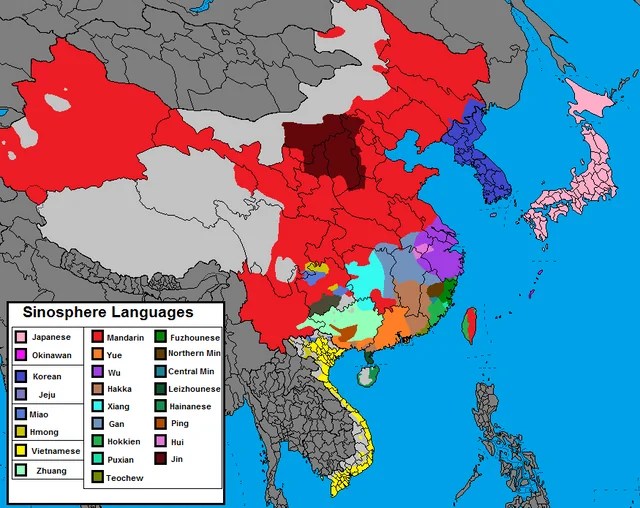
Much like Latin in medieval and early modern Europe, Classical Chinese once served as the dominant language of scholarship, governance, and diplomacy in East Asia. For centuries, it was the written lingua franca in Vietnam, Korea, and Japan—used in official documents, court rituals, and elite education.
Just as the Vatican eventually turned to vernacular languages for accessibility and pastoral engagement, these East Asian societies gradually adopted local scripts and languages for official and literary use:
- Vietnam transitioned from Classical Chinese to chữ Nôm and eventually to quốc ngữ (Latin script).
- Korea moved toward Hangul while still using Chinese characters for scholarly and official purposes until the 20th century.
- Japan developed a hybrid writing system combining kanji (Chinese characters) with kana.
🌏 The Sinophone/Sinosphere Timeline
| Country/Region | Period of Chinese Script Use | Key Notes |
|---|---|---|
| China (Central) | ~1200 BCE – present | Oracle bone script to modern Chinese; the origin of the script and literary tradition. |
| Korea | 4th century CE – 1894 (official) Continued in scholarly use into the 20th c. | Adopted Chinese script (Hanja). Native script Hangul created in 1443 but Classical Chinese remained dominant in formal writing until Gabo Reforms (1894). |
| Japan | 5th century CE – ~19th century Continued use in some scholarly/liturgical circles | Used Classical Chinese (Kanbun) for formal writing. Kana developed around 9th century. Meiji reforms (~1868–1912) shifted focus to vernacular Japanese. |
| Vietnam | 2nd century BCE – 1918 (official end) | Used Classical Chinese (chữ Hán); chữ Nôm developed by 13th c. French colonial reforms in 1918 ended its official use. |
| Ryukyu Kingdom (Okinawa) | ~15th century – 19th century | Used Classical Chinese in diplomacy with China. |
| Mongolia | Yuan Dynasty (1271–1368) – Qing era | Used Classical Chinese in court, though Mongolian script and Tibetan also coexisted. |
| Tibet | Tang dynasty influence ~7th century – Qing | Used Chinese in official Qing correspondence, but Tibetan was dominant. |
| Manchuria | Qing Dynasty (1644–1912) | Manchu used alongside Chinese in administration. Chinese was dominant in civil bureaucracy. |
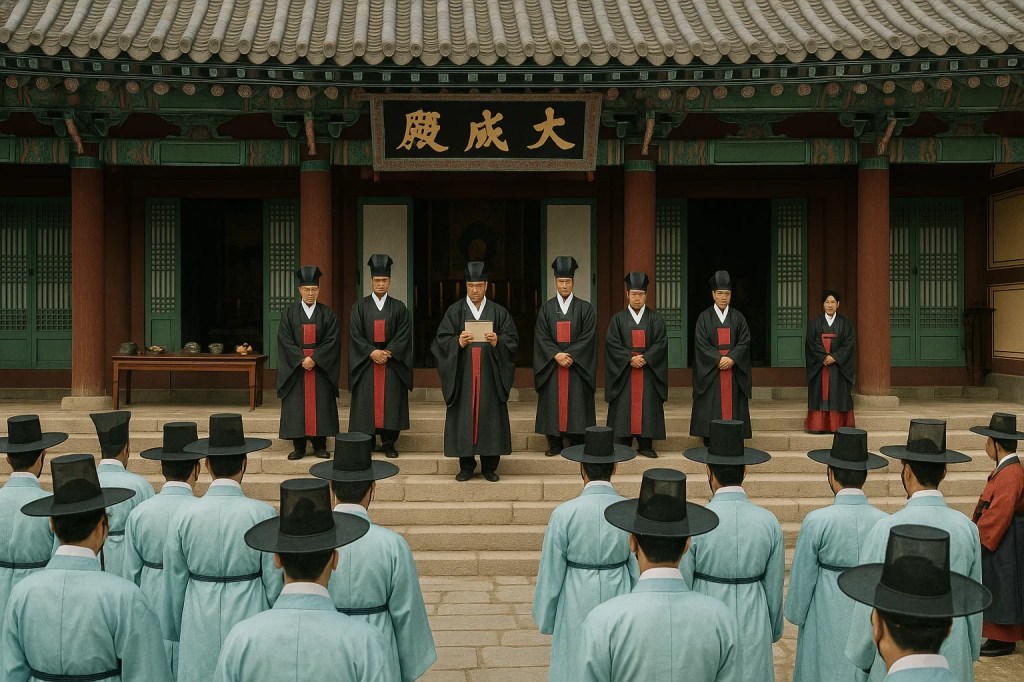
In modern-day South Korea, Classical Chinese (Hanja and Literary Chinese) is still used ceremonially in ancestral rites (제사 Jesa or 차례 Charye) and Confucian rituals.
Below is an example of a 祝文 (zhùwén / jubun)—a ritual eulogy or prayer read aloud during Confucian ceremonies in both Korea (Seokjeon Daeje) and China (Confucius Memorial Ceremony, 孔子祭典). Despite regional variations in pronunciation and ritual form, the Classical Chinese text remains nearly identical.
| Classical Chinese | Hanja | Korean (RR Romanisation) | Mandarin (Pinyin) |
|---|---|---|---|
| 惟聖道高明,垂訓萬世。 | 유 성도 고명, 수 훈 만세. | yu seong-do go-myeong, su hun man-se | wéi shèng dào gāo míng, chuí xùn wàn shì |
| 教人以孝弟忠信,導民於仁義禮智。 | 교 인 이 효제 충신, 도 민 어 인의 예지. | gyo in i hyo-je chung-sin, do min eo in-ui ye-ji | jiào rén yǐ xiào tì zhōng xìn, dǎo mín yú rén yì lǐ zhì |
| 風化既彰,兆庶咸悅。 | 풍화 기 창, 조서 함열. | pung-hwa gi chang, jo-seo ham-yeol | fēng huà jì zhāng, zhào shù xián yuè |
| 功施天下,德配天地。 | 공 시 천하, 덕 배 천지. | gong si cheon-ha, deok bae cheon-ji | gōng shī tiān xià, dé pèi tiān dì |
In both cases, Latin and Classical Chinese have receded into symbolic or historical roles, still studied and used in select contexts but no longer central to daily religious, academic, or governmental life.
🔍 In Summary
Latin has declined in papal usage due to liturgical reforms, globalisation, and the need for direct pastoral communication. Meanwhile, modern popes speak an impressive range of languages across Romance, Germanic, and Slavic families, embracing a truly global Church.
The story of Latin finds a mirror in Classical Chinese’s former prominence in East Asia—a shared tale of ancient prestige giving way to modern pragmatism.
VaticanLanguageShift #LatinDecline #PapalLanguages #VaticanII #PopeFrancis #MultilingualPope #CatholicChurchLanguages #LatinInChurch #PapalCommunication #VaticanPolicy #LanguageEvolution #ChurchHistory #PapalLegacy #VaticanNews #LanguageAndReligion #PapalLanguages1900s #ModernPapalLanguages #VaticanStudies #ChurchLanguagePolicy #PapalMultilingualism





 BL Translations