

If you need your Australian documents recognised overseas, the Department of Foreign Affairs and Trade (DFAT) can help. DFAT provides a range of notarial services, including document legalisation, both by mail and in person through Australian Passport Offices across the country.
When do you need to legalise a document?
Only the overseas authority requesting your document can confirm whether legalisation is necessary. This might be a foreign government agency, business, educational institution, or organisation.
👉 Always check with them first — DFAT cannot advise whether your documents must be legalised.
What documents DFAT can legalise
DFAT can only legalise Australian public documents, including:
- Original documents issued by Australian government agencies or officials
- Original academic documents issued by Australian tertiary institutions
- Copies that have been notarised by an Australian Notary Public
Other types of documents can’t be legalised in Australia.
📧 For detailed guidance, contact DFAT via legalisations.australia@dfat.gov.au or reach out online.
How to get your documents legalised in Australia
Step 1. Prepare your documents
- Confirm with the overseas authority which documents require legalisation.
- Check DFAT’s list of eligible documents.
- Determine whether your document needs an apostille or authentication certificate.
- Gather all necessary originals.
- If your document isn’t an original Australian public document, take it to a Notary Public for notarisation.
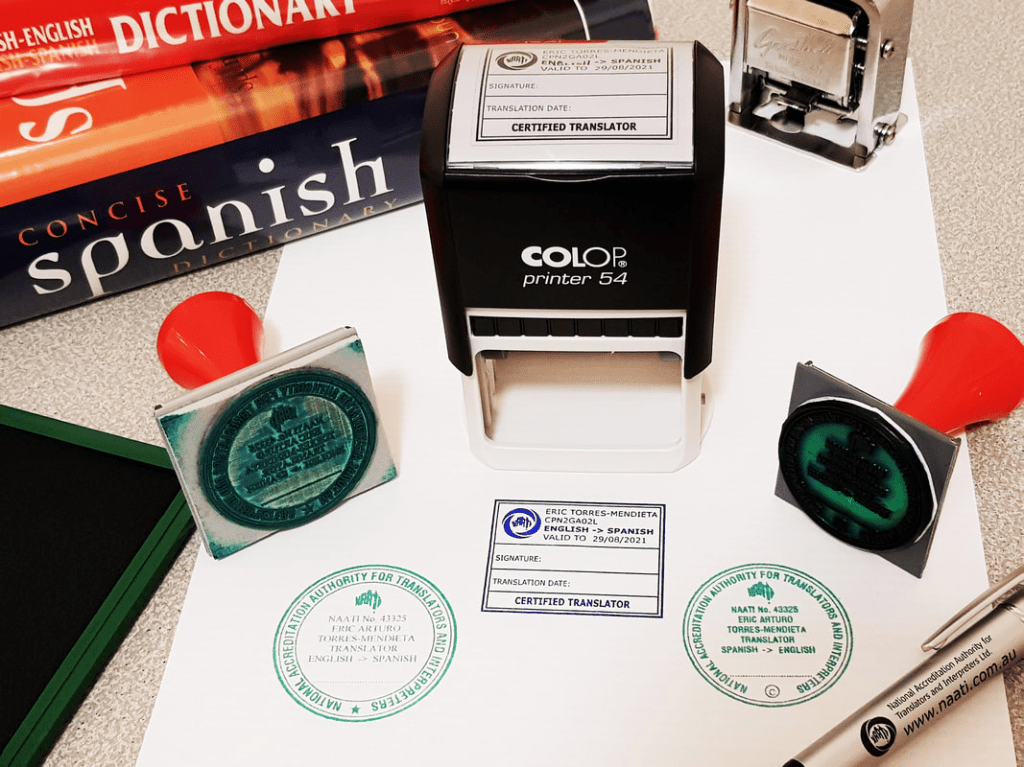
Suppose you need the legalised documents to be translated into a language other than English so that they can be used in a foreign country. In that case, you need to receive your NAATI certified translation before Step 2 so that DFAT can verify a NAATI practitioner’s stamp, meaning that the translation will be considered officially legalised by DFAT.
Step 2. Submit your request
You can request DFAT’s services in person or by mail.
To start, complete the Document Legalisation Request Form accurately — incomplete forms will not be processed.
Step 3. Submit your documents
Option 1: In person
Make an appointment at your nearest Australian Passport Office:
Adelaide | Brisbane | Canberra | Darwin | Hobart | Melbourne | Perth | Sydney
You’ll need:
- All required documents and forms
- A credit or debit card for payment
- A self-addressed registered post envelope if you’d like the legalised documents returned by mail
Someone else can attend on your behalf. Remember — if anything is missing, DFAT cannot process your request on the spot.
Option 2: By mail
Send your application via registered post to:
Australian Passport Office Authentications Section
GPO Box 2239
MELBOURNE VIC 3001
or
Australian Passport Office Authentications Section
GPO Box 2239
SYDNEY NSW 2001
Include:
- The completed request form
- Original documents
- Credit card authorisation (see section 7 of the request form)
- A self-addressed registered post envelope for return delivery
Keep both tracking numbers — DFAT is not responsible for items lost in the mail.
Step 4. Pay the fee
- Apostille or authentication certificate: $102
(Fees are adjusted annually on 1 January in line with the Consumer Price Index.)
Step 5. Processing and return
DFAT officers will verify the signature or seal on your documents against official records. Once verified, they will issue an apostille or authentication certificate directly on the document.
If verification requires confirmation from the issuing authority, processing may take longer.
You can collect your documents in person or have them returned via post using your supplied envelope.
⏱️ Processing times vary depending on demand, especially during end-of-year and holiday seasons. Incomplete applications will be returned with a note explaining what’s missing.
For further assistance, you can email legalisations.australia@dfat.gov.au.
🔖 Useful Hashtags
#DFAT #Australia #DocumentLegalisation #Apostille #Authentication #NotarialServices #AustralianPassportOffice #LegalDocuments #OverseasUse #AustralianGovernment #StudyAbroad #VisaDocuments #InternationalRecognition #OfficialDocuments #TravelAustralia



 BL Translations