
This article outlines the requirements set by the Department of Foreign Affairs and Trade (DFAT) regarding translations completed by NAATI credentialed translators in Australia. DFAT has specified that translations must include particular information in order to be accepted for legalisation.
DFAT frequently receives copies of translations because Australian documents often require a form of legalisation before foreign governments or organisations will accept them. Legalisation by DFAT occurs in two forms: the affixing of an apostille, which verifies the validity of a signature or seal, or a chain of authentications confirming signatures and/or seals.
For translations, DFAT’s legalisation process applies specifically to the signature or seal of the NAATI translator.
NAATI Stamp – Official Certificate
Given NAATI’s role as the national standards and certification body for translators and interpreters in Australia, DFAT treats the stamp or signature of a NAATI credentialed translator as an official certificate for the purposes of issuing an apostille.
However, this is only accepted when the stamp/signature is accompanied by additional information designed to protect the integrity of NAATI, the translator, and DFAT.
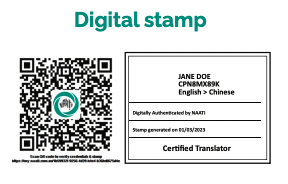
Accordingly, DFAT requires that every translated page submitted for legalisation must display the translator’s NAATI stamp (physical or digital) clearly showing:
- the translator’s practitioner ID; AND
- their language and type of certification; AND
- their name as the translator; AND
- the date of the translation (for a physical stamp) OR the date the digital stamp was generated; AND
- the translator’s signature (for a physical stamp) OR the phrase “Digitally Authenticated by NAATI” (for a digital stamp); AND
- the web address beneath the QR code must be clearly legible (applicable only to digital stamps), noting that resizing the digital stamp too small can render this illegible.
In addition, DFAT requires that an original or a copy of the original document, signed or stamped by the translator, must accompany the translation.
NAATI has advised that practitioners adopt this practice as a standard procedure for all translation work.
Policy on Translations by Accredited Translators
DFAT has stated that, from 1 July 2018, it can only accept translations completed by translators with NAATI certification under the current Certification System, which includes Recognised Practising credentials. The department will no longer accept translations completed by individuals holding NAATI accreditation issued under the former accreditation system after that date.
Unacceptable/Recognised NAATI Stamp by DFAT
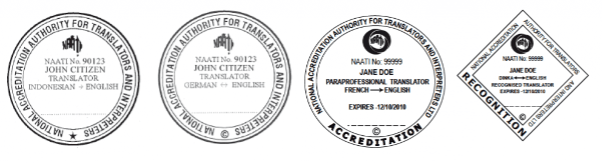
Translations that are dated before 1 July 2018 remain unaffected and will continue to be accepted.
Policy on Translating Official Australian Government Seals and Stamps
DFAT has also clarified that translators must not alter the appearance of official Australian Government stamps or seals. These elements must remain in their original format. Where clarification is required, translators may add the word “Seal” in brackets next to the stamp or seal.
Further Enquiries
DFAT has advised that any further questions regarding this policy or the document legalisation process can be directed to:
legislations.australia@dfat.gov.au.
Acceptable and Recognised NAATI Stamps by DFAT

Ways to Verify a NAATI Translation
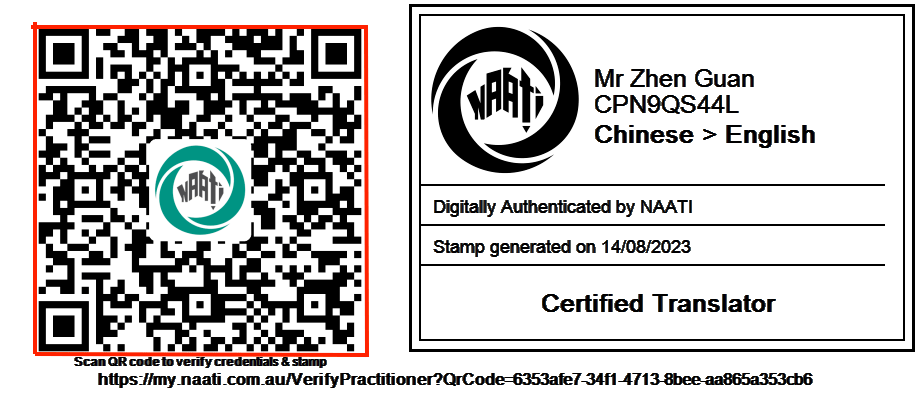
Scan the QR Code – NEW FEATURE!
By scanning the QR code found on the digital translator stamp or ID card.
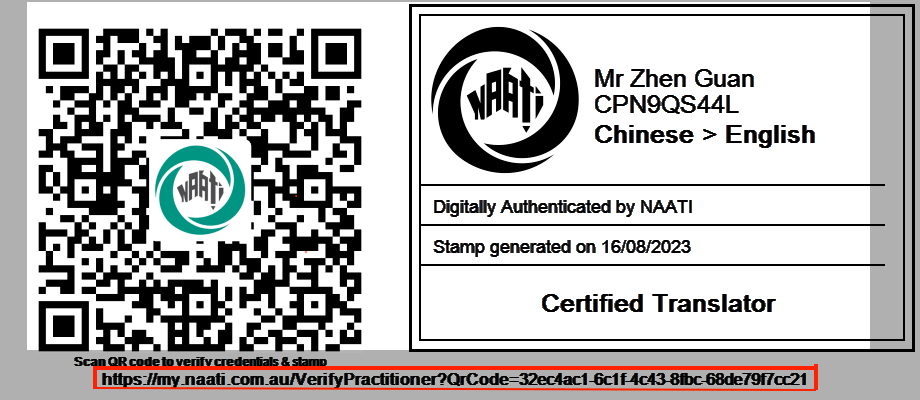
32-Character identifier – NEW FEATURE!
By entering the unique 32-character identifier located below the QR code on the digital stamp.

CPN No. for Verification
By using the “Verify a Credential” tool on the NAATI website allows users to input the CPN number for verification.

So what does it mean for clients?
Pros
- Quick verification of the translator’s status can be done by scanning the QR code on the digital stamp or ID card.
- The authenticity of the NAATI stamp can be easily confirmed by entering the unique 32-character identifier below the QR code.
Cons
- No reported disadvantages for clients thus far.
Standard Physical NAATI Certification Stamps
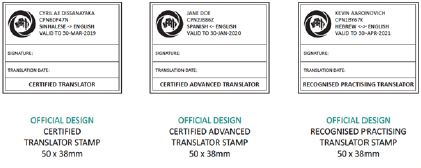
It’s important for clients to understand that NAATI stamps issued to practitioners through the NAATI certification system, including certified translators, certified advanced translators, or recognised practicing translators, will appear as depicted in the provided images.
Old NAATI Accreditation Stamps
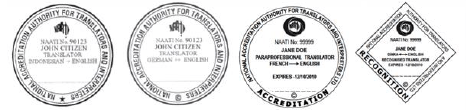
NAATI no longer issues certain stamps issued under the old accreditation system before January 2018. Translations containing these stamps, however, retain their validity indefinitely. Clients should confirm with the requesting agency whether the accreditation stamp is still acceptable.
Common confusion surrounds the validity of NAATI translations.
Does a NAATI translation has an expiry date?
NAATI translations do not have an expiry date. Even if the “valid to” date on the NAATI stamp has passed, the translation itself remains valid indefinitely.
My NAATI translation has a stamp from the old accreditation system. Can I still use it?
Translations featuring stamps from the old accreditation system are still usable. It’s advisable for clients to check with the requesting agency regarding the acceptance of such stamps, as many Australian departments and agencies have ceased accepting old NAATI stamps, including DFAT.
What if there is a mismatch between “Valid To” Date and Completion Date on my translation?
If the “valid to” date on the NAATI stamp has already passed while the translation was completed later, such as the stamp indicating “Valid to 1 July 2023” and the translation being finished on 1 August 2023, clients should initially consult with their translator. This discrepancy may arise from the accidental use of a previous NAATI stamp.
NAATI’s perspective emphasises that if a translation is completed before the expiration date (“valid to” date) mentioned on the stamp, falling within the valid period, it should be accepted wherever submitted. However, the opposite scenario might not hold true.
#DocumentLegalisation #Apostille #Authentication #DFAT #NotarialServices #NAATITranslation #AustraliaLife #OverseasDocuments #LegalisationProcess #InternationalUse #AustralianDocuments #ConsularServices




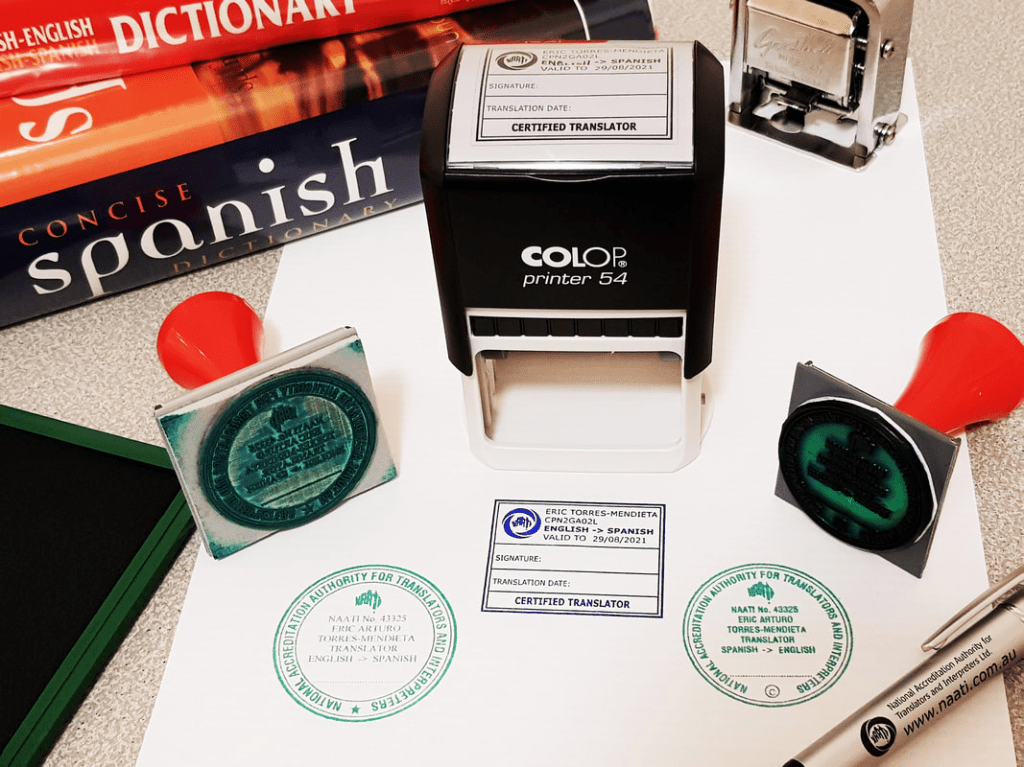
 BL Translations