
As a Mandarin/Chinese interpreter and translator, I’ve watched the rapid rise of AI and the explosion of cheap, online language tutorials with mixed feelings. On one hand, it’s incredible that anyone can now learn a new language from their phone. On the other hand, some prices are so low that I genuinely wonder how much money actually reaches the tutors themselves.
Naturally, this environment makes you wonder: How easy would it be for an interpreter or translator to expand their professional language portfolio?
After all, if polyglot YouTubers can effortlessly move between 7 or 8 languages, surely trained language professionals could follow the same path?
But as language professionals, we constantly remind the public about the difference between language learning and translation/interpreting.
Now, we need to confront that same reality ourselves.

Being a Professional Interpreter Is Not the Same as “Knowing a Language”
Interpreting is not about holding a casual conversation.
It is about functioning professionally across contexts, adapting to formal and informal registers, having multiple ways to express meaning, and being able to work confidently across a wide range of topics. It requires mental flexibility, deep cultural competence, and vocabulary breadth.
This is not easy. And it is certainly not a casual commitment.
Just like professional development (PD), developing a working LOTE requires ongoing training so you can perform beyond a social-chat level.
If we borrow the European language proficiency framework, an interpreter or translator should realistically operate at C-level or above. Anything lower and even moderately challenging contexts become overwhelming.
So, If You Already Work in English + One LOTE, What Should LOTE 2 Be?
This discussion is for serious professionals who already:
- Work in the language services industry
- Are proficient in at least two languages
- Perform translation, interpreting, subtitling, or voiceover
- Understand that this is a professional investment, not a hobby
We also assume you are already proficient in English + at least one LOTE.
So the real question becomes:
➡️ What should your second LOTE be, if your goal is to use it professionally?
This second language should be:
- Native-like or near-native
- Significant economically, socially, culturally, or professionally
- A strategic choice, not a sudden personal impulse
To evaluate that, we must look at several factors relevant to your country of residence:
- Language families — especially for English and your current LOTE(s)
- Similar languages provide “shortcuts”
- Major community language groups
- Community interpreting demand depends on population
- Major trading partners
- High-level work (delegations, MoUs, bilateral events) follows trade lines
- Most spoken languages worldwide
- Indicates global demand
Let’s go through each point.
I. Language Families
Languages behave like cuisines.
If you enjoy Spanish food, chances are you’ll also be comfortable with Italian or French cuisine. Chinese cuisine, however, might be an acquired taste.
Languages work the same way.
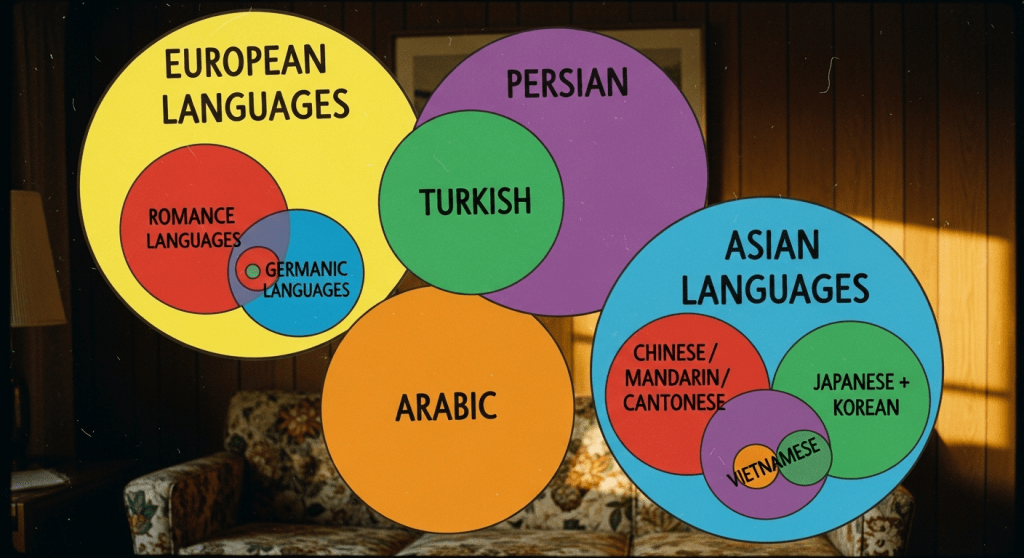
So let’s map the families relevant to major global languages.
1. Indo-European Family
Germanic:
- English, German, Swedish, Danish
Romance:
- French, Spanish, Italian, Portuguese
Slavic:
- Russian, Polish, Ukrainian
Hellenic:
- Greek
2. Major Asian Languages (Various Families)
European languages share similarities thanks to the Indo-European umbrella.
Asian languages do not. They sit in distinct families and offer no shortcuts to one another.
Sino-Tibetan:
- Mandarin Chinese
- Cantonese
Austroasiatic:
- Vietnamese
- Khmer (Cambodian)
Japonic:
- Japanese
Koreanic:
- Korean
3. Middle Eastern Languages (Afro-Asiatic & Indo-European)
Afro-Asiatic (Semitic):
- Arabic
- Hebrew
Indo-European (Iranian branch):
- Persian (Farsi)
- Kurdish
- Pashto
Turkic family:
- Turkish
- Uzbek
- Kazakh
II. Top Community Languages in Australia
Based on the 2021 Australian Census, these are the top 10 non-English home languages:
- Mandarin — 685,274 people (~2.7%)
- Arabic — 367,159 (~1.4%)
- Vietnamese — 320,758 (~1.3%)
- Cantonese — 295,281 (~1.2%)
- Punjabi — 239,033 (~0.9%)
- Greek — 229,643 (0.9%)
- Italian — 228,042 (0.9%)
- Filipino/Tagalog — 131,195 (0.5%)
- Hindi — ~196,000 (0.8%)
- Spanish — 171,370 (0.7–0.8%)
III. Australia’s Top Trading Partners
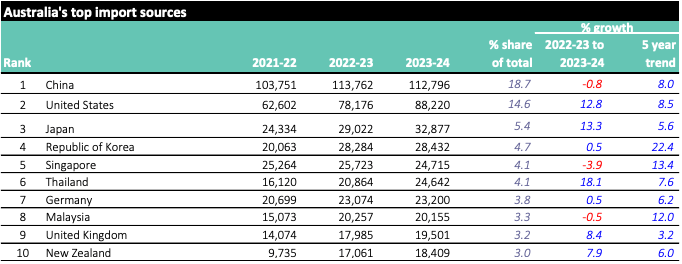
Based on ABS/DFAT 2023–24:
- China — #1 export & import partner
- United States — #4 Export, #2 Import
- Japan — #2 Export, #3 Import
- South Korea — #3 Export, #4 Import
- Singapore — (below top-5) Export, #6 Import
- Thailand — (below top-5) Export, #5 Import
- Germany — (below top-5) Export, #7 Import
- Malaysia — (below top-5) Export, #8 Import
- United Kingdom — (below top-5) Export, #9 Import
- New Zealand — (below top-5) Export, #10 Import
Translating that into languages:
- Chinese
- Japanese
- Korean
- Thai
- German
- Malay/Indonesian
IV. Most Spoken Languages Worldwide (Top 8)
- English — 1.5B total speakers
- Mandarin Chinese — 1.1B
- Hindi — 600M
- Spanish — 580M
- French — 300M
- Arabic — ~310M
- Bengali — ~273M
- Portuguese — ~264M
Consolidated List (Before Removing English-Proficient Groups)
By merging the four datasets and grouping languages into broader families, the top 10 looked like this:
- Chinese – Mandarin/Cantonese (4 occurrences)
- Indian Languages (3)
- Roman Languages (3)
- Arabic (2)
- Greek (2)
- German (2)
- Japanese (2)
- Korean (2)
- Vietnamese (2)
- Turkish Languages (1)
But This List Requires One More Filter
We must account for countries or groups with:
- Higher English proficiency
- Official documents widely issued in English
Why? Because:
- Higher English proficiency = lower community interpreting demand
- English-issued documents = lower NAATI translation demand
This directly affects your income and service offering.
Indian languages fall into this category.
English is widely used across India, and many official documents are issued in English, reducing the need for NAATI-certified translation.
Final Top 10 (After Removing Indian Languages)
- Chinese – Mandarin/Cantonese (4 occurrences)
- Roman Languages (3)
- Arabic (2)
- Greek (2)
- German (2)
- Japanese (2)
- Korean (2)
- Vietnamese (2)
- Turkish Languages (1)
- Persian (Farsi) (1)
Other languages worth considering: Thai and Indonesian/Malay.
Expanding Strategically: Two Approaches
1. Expanding From Your LOTE
If your LOTE is a Romance language:
Add the others — French, Italian, Spanish, Portuguese.
They are partly mutually intelligible and expand your market, mostly for translation.
If your LOTE is German:
Roman languages are the most profitable and easiest additions.
If your LOTE is Chinese:
Cantonese is the only straightforward add-on (for interpreting).
Japanese, Korean, and Vietnamese all pose similar difficulty, though Japanese feels familiar because of shared characters.
If your LOTE is Vietnamese:
Chinese/Mandarin/Cantonese is a natural next step thanks to tonal structure and shared vocabulary.
If your LOTE is Korean or Japanese:
The natural extension is each other.
Chinese or Vietnamese can be third options.
If your LOTE is Arabic or Turkish:
Persian is a logical follow-up.
2. Expanding From English
The natural choices are:
- French
- Italian
- Spanish
- Portuguese
- German
As someone whose native language is Mandarin, I can say that learning French was far easier for me than learning Cantonese. Indo-European languages share high similarity, thanks to common Latin roots.
Final Thoughts
Choosing your next professional language is not a casual decision. It can shape:
- Your future career
- Your market positioning
- Your professional identity
- Your income
So choose strategically, informed by community needs, economic factors, and linguistic reality.

#️⃣ #InterpreterLife #TranslatorJourney #LanguageProfessionals #MultilingualCareers #PolyglotPath #NAATI #AustraliaInterpreting #LanguageLearningProfessionally #InterpreterTips #TranslatorTips



 BL Translations