
BL Official Translation Guidelines
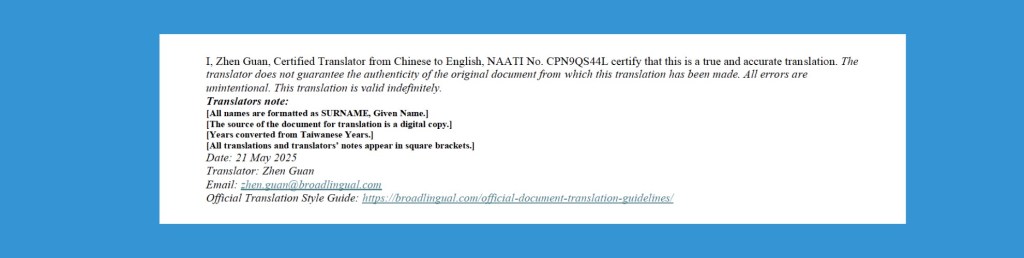
| At BL Translations, we adhere strictly to the best practices for the translation of official and legal documents. All translator’s notes are clearly indicated within square brackets to distinguish them from the translated content. Our translators work diligently and translate to the best of their knowledge and ability, certifying that each translation is a true and accurate representation of the original document. Please note, however, that we do not verify or guarantee the authenticity of the source document from which the translation is produced. Should clients require verification of the original document’s authenticity, we can facilitate liaison with qualified professionals, such as a Justice of the Peace or Notary Public, prior to commencing the translation. While every effort is made to ensure accuracy, any errors or omissions are unintentional. This translation remains valid indefinitely unless otherwise stated. |
Certified Translation Factsheet
Welcome to our guide on how certified translations are presented and what details are included. This factsheet explains how your document will be translated and formatted for official use in Australia or overseas.
1. Heading of the Translation
The heading at the top of a NAATI-certified translation clarifies several key aspects of the work. It will typically include:
- Languages:
Example:Translation from Japanese to English - Document Type and Country of Issue:
Example:Marriage Certificate [Spain]
If the country of issue is not specified on the source document, it may be added in square brackets. - Certification Status:
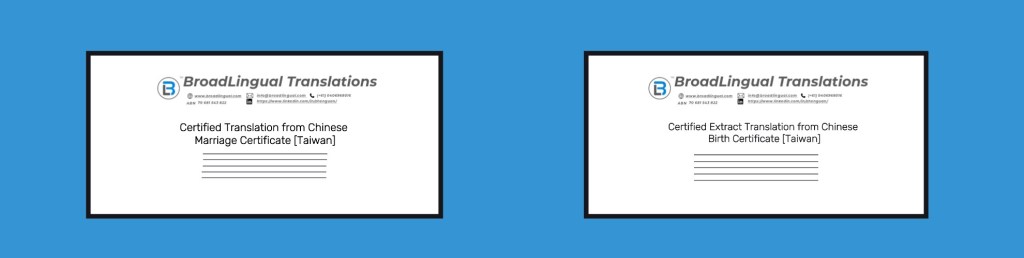
Examples:Certified Translation from ChineseCertified Extract Translation from Spanish - Full vs. Extract Translation:
- A Certified Translation indicates a full translation of the entire source document.
- A Certified Extract Translation means that only selected parts of the document have been translated.
- Note: The decision to request a full or extract translation rests with the client, not the translator.
2. Status of the Source Document
It is important to specify how the source document was received. This helps establish the document’s chain of custody and its level of authenticity.
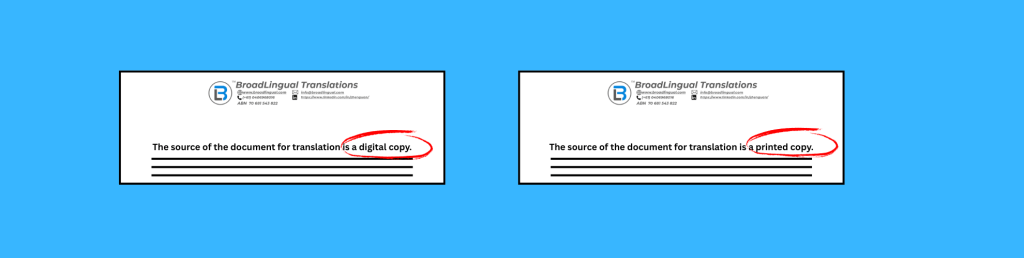
- Electronic Copy:
Received via email or online upload. - Original:
A physical document bearing original stamps or signatures from the issuing authority. These documents are usually delivered in person or via courier. - Certified Copy / Certified Photocopy:
A copy certified by an authorised person (e.g. Justice of the Peace, Notary).
The certifier’s name, title, and place of certification will be included in the translation.
Note: NAATI Certified Translators do not verify or guarantee the authenticity of source documents. They only translate what is presented.
3. Format and Layout
Certified translations aim to mirror the format and layout of the original document where feasible.
- Blank or unfilled fields appear as:
[No Entry] - Signatures are marked as:
[Signature]or[Signed] - Seals and Stamps appear as:
[Seal]or[Stamp] - Logos, Taglines or Slogans are noted as:
[Logo],[Tagline],[Slogan]
These items are not copied from the original. They are described using translator’s notes in square brackets.
“Copying and pasting the above-mentioned content between documents may obscure the distinction between the source (original) text and the translated version, making it difficult for the requesting authority to verify authenticity. Translators should therefore ensure that the original and the translation are clearly separated, properly labelled, and formatted to avoid any confusion.“


4. Certified Documents & Attestations
If your source document includes a certification, authentication, or official endorsement, the translation will note this, including:
- Name of the issuing authority or certifier
- Place and date of certification
- Reference or certificate number (if applicable)
Example heading:
Certified Translation of a Certified Household Registration [Taiwan]
5. Special Features in the Source Document
Certain visual features on the document are described to ensure accuracy and transparency:
- [Erased] – something has been visibly erased
- [Handwritten] – handwritten text or edits
- [Deleted] – text has been removed or struck through
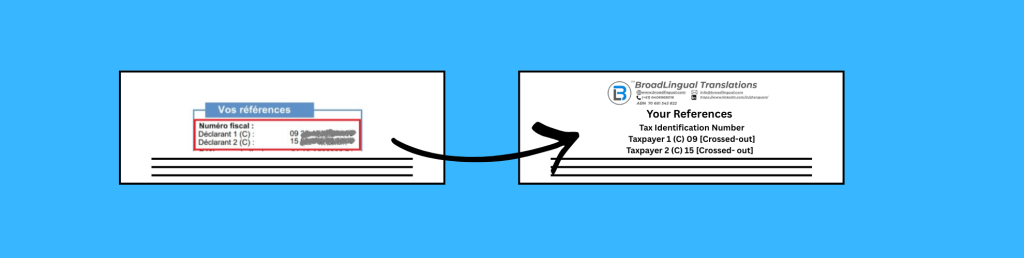
- [Crossed-out] – content visibly crossed out
Translators will translate legible content even if it is marked as deleted or corrected.
6. Translator’s Notes
All translator notes are enclosed in square brackets [ ]. Common examples include:
[Source document is a certified photocopy][Translator’s notes are in square brackets][Years are converted from Taiwanese calendar](or similar conversions from non-Gregorian systems)[ABC is the abbreviation for Australian Broadcasting Corporation]
7. Page Alignment in Official Translations
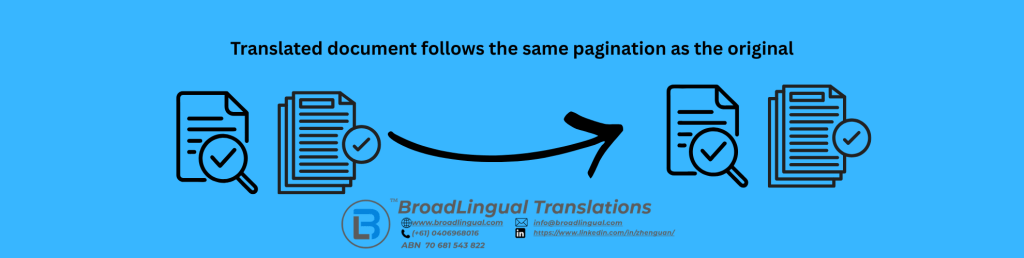
For translations intended for official or legal purposes—such as court submissions—it is generally required that each page of the source document corresponds to a single page in the translated version. This one-to-one page alignment ensures consistency, ease of reference, and accurate comparison between the source and translated texts.
Translators should be aware that translating from languages other than English (LOTE), such as Chinese, Japanese, and others, often results in text expansion due to linguistic and structural differences. In such cases, it may be necessary to adjust the font size, spacing, or formatting—within reasonable and legible limits—to ensure that the translated content fits within the same page range as the source document. This should be done without compromising the accuracy, readability, or integrity of the translation.
Where strict page alignment cannot be achieved without affecting the quality of the translation, the translator should note this clearly in the translator’s declaration or provide a brief explanation as a translator’s note.
To facilitate alignment and cross-referencing, translators may include notations such as:
- [Source document page 1 continues]
- [End of source document page 1]
- [Source document page 2 starts]
“Exceptions may apply to common personal documents where the original text and the translation are presented on the same page, or where an extract or summary translation is prepared from multiple source pages. In such cases, the translator must clearly distinguish and label the original content and the translated text, and explicitly indicate where the document constitutes an extract or summary translation, to ensure transparency and avoid any potential confusion.“
Important Reminders
- Certified translations are designed for official and legal purposes.
- NAATI translators are authorised to translate, but not to verify or validate the authenticity of the original document.
- If you are unsure whether you need a full or extract translation, please check with the requesting authority (e.g. immigration, courts, academic institutions).
Reference
This factsheet has been prepared with reference to the
Australian Institute of Interpreters and Translators (AUSIT) Inc
Best Practices for the Translation of Official and Legal Documents
 BL Translations