
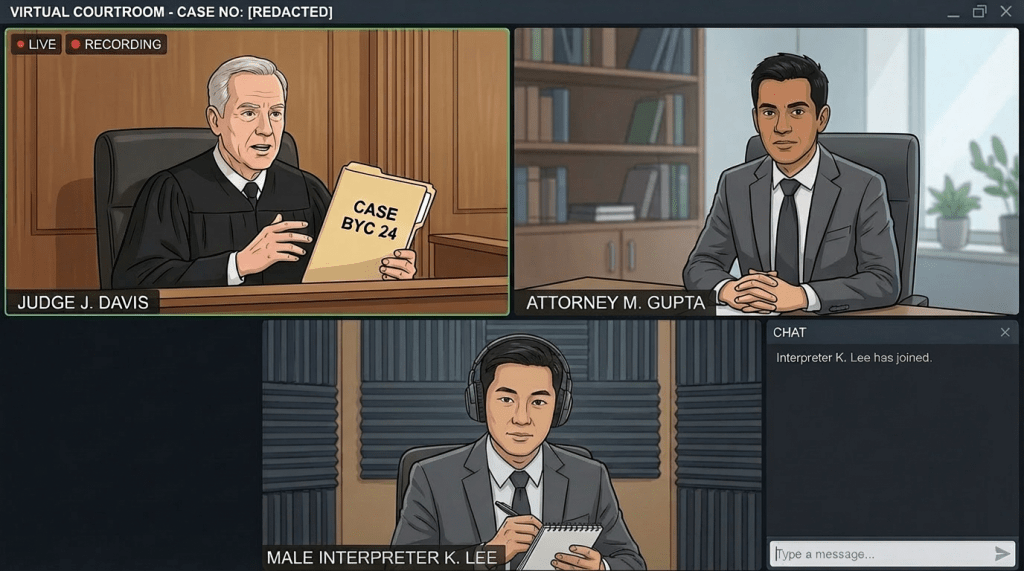
The recent decision in BYC24 v Minister for Immigration and Multicultural Affairs (No 2)
has drawn attention to an important procedural issue: how tribunals should approach contacting applicants after long periods of inactivity.
This discussion is particularly relevant not only for migration practitioners and applicants, but also for legal interpreters working in migration matters.
This article provides general commentary on publicly available case law. It does not constitute legal advice.
What Happened in BYC24?
The matter involved a protection visa review in which the applicant failed to attend a Tribunal hearing.
The Tribunal had sent a hearing invitation to the applicant’s last known email address. When the applicant did not appear, the application was dismissed.
The applicant later argued that the invitation had never been received. Given the extended period of delay in processing the case, the Court examined whether simply sending notice was sufficient to satisfy procedural fairness.
The decision placed focus on a broader question:
After a long period of inactivity, is technical compliance with notification provisions always enough?
Key Principles Emerging from the Decision
Long Delays May Affect Procedural Expectations
Where there has been prolonged inactivity:
- Applicants may reasonably assume the matter is dormant
- Contact details may have changed
- Email accounts may become inactive
- Engagement with the process may diminish over time
The Court indicated that extended silence can alter the practical fairness analysis. In certain circumstances, a single attempt at contact may not be sufficient.
This does not create a universal rule. Rather, it signals that context matters.
Sending Notice vs Effective Communication
A significant feature of the reasoning was the distinction between:
- Formal compliance (sending notice in accordance with statutory requirements), and
- Practical fairness (whether the applicant realistically had a genuine opportunity to participate).
The case highlights that procedural fairness is not purely mechanical. Courts may consider whether communication was effective in a practical sense, particularly where unusual delays exist.
Non-Appearance Is Not Always Determinative
Dismissal for failure to attend is not automatically immune from challenge.
Where there is credible doubt about whether an applicant actually received notice — especially after extended processing delays — reinstatement may be considered.
Again, the emphasis is fact-specific. The outcome turns on the circumstances of the individual case.
The Counter-Argument You Are Likely to Hear
While BYC24 strengthens attention to fairness after prolonged delay, it does not apply universally.
In practice, decision-makers or Ministerial representatives may attempt to distinguish the case.
Common distinguishing arguments include evidence that:
- The applicant contacted the Tribunal during the waiting period
- Official letters were requested
- There was ongoing correspondence
- The applicant demonstrated awareness of the proceedings
- Engagement continued in the lead-up to the hearing
Where there has been active communication, it may be argued that the applicant could reasonably be expected to monitor communications and anticipate further contact.
In such scenarios, prior engagement can significantly weaken claims of surprise or non-receipt.
This illustrates how the same authority can be invoked by both sides — but interpreted differently depending on the facts.
Why This Case Matters for Legal Interpreters
For interpreters working in migration hearings, familiarity with such case law is not merely academic.
Legal interpreting requires:
- Recognition of procedural terminology
- Understanding the structure of submissions
- Identifying when a case is being distinguished
- Maintaining coherence when abstract legal concepts are debated
In hearings influenced by decisions like BYC24, an interpreter may hear statements such as:
- “This matter is distinguishable from BYC24.”
- “The applicant maintained active engagement.”
- “Notice was reasonably expected to be received.”
- “Procedural fairness requirements were satisfied.”
Without awareness of the broader legal context, accurately rendering these submissions in real time can be significantly more challenging.
Reasonable Prediction as Professional Competence
Experienced legal interpreters often rely on what might be described as “reasonable prediction” — informed anticipation based on subject-matter familiarity.
You may never interpret another case identical to BYC24. However, understanding its principles enables you to anticipate:
- The likely vocabulary used in submissions
- The direction of procedural fairness arguments
- Points of factual distinction
- The register and tone of courtroom advocacy
This preparedness enhances accuracy and supports professional confidence under pressure.
Practical Reflections for Applicants and Practitioners
Although this article does not provide legal advice, the case illustrates broader themes:
For applicants:
- Keep contact details updated
- Monitor nominated email accounts
- Maintain records of correspondence
For representatives:
- Evidence of ongoing engagement can be decisive
- Documentation may rebut claims of non-notification
- Procedural fairness arguments are intensely fact-driven
A Case Worth Watching
Migration decisions carry profound personal consequences. BYC24 reinforces that administrative efficiency must be balanced against fairness — particularly where long periods of silence precede critical communication.
At the same time, the decision demonstrates that fairness arguments depend heavily on factual context. Prior engagement may fundamentally alter the analysis.
For interpreters, this underscores an important professional truth: subject-matter knowledge is not optional. It strengthens accuracy, supports ethical performance, and empowers the interpreter to navigate complex legal discourse with clarity.
Understanding the law does not mean giving legal advice — but it does mean being prepared.


 Broadlingual Translation