
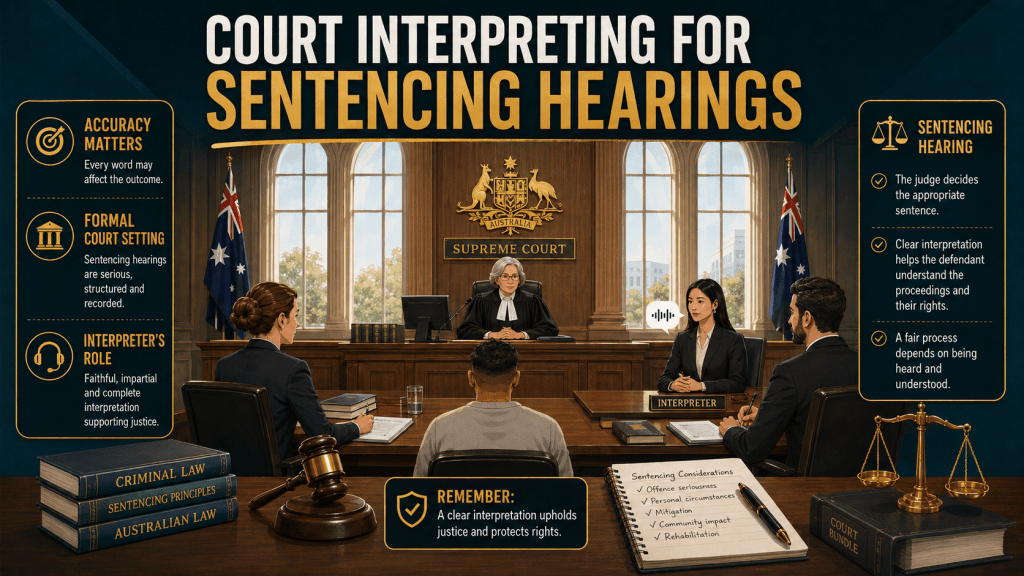
Sentencing Hearings Are Not Always Straightforward
Court interpreting in a sentencing hearing can be highly demanding, especially in the District Court or Supreme Court. On paper, it may look like a single court booking. In practice, the way the hearing runs can vary significantly.
Sometimes the interpreting may be mostly simultaneous. Sometimes it may need to be consecutive. Sometimes the courtroom equipment, available devices, or layout will determine how the interpreter can work.
For this reason, a sentencing hearing is rarely something an interpreter should walk into blindly.
A Small Piece of Background Can Make a Big Difference
For criminal matters, especially serious matters such as drug trafficking, there may be limited media coverage or a public news release. Even a short media report can help the interpreter understand the nature of the case, the alleged conduct, and the general background.
Of course, media reports are not court documents. They should not replace proper briefing. However, they may give the interpreter a starting point, especially when the booking information from the language service provider is very limited.
In many interpreting portals, the available information may be as vague as:
| Information Provided | Why It May Not Be Enough |
|---|---|
| “Criminal matter” | Does not identify the actual offence |
| “Drug trafficking” | Does not explain the factual background |
| “Sentencing” | Does not explain what stage the case has reached |
| Court location and time | Useful logistically, but not enough for preparation |
For interpreters, this lack of background is a real challenge. We are expected to perform accurately, but accuracy depends heavily on context.
Why Interpreters Should Ask for the Right Document
One practical lesson from this experience is simple: ask for a specific document, not a long list of general information.
For a sentencing hearing, one useful document may be the indictment. It can help the interpreter understand the charge, the wording of the offence, and the structure of the case.
Instead of sending a long email asking for 10 or 20 different details, it may be more effective to make a short, precise request.
For example:
| Less Effective Request | Better Request |
|---|---|
| “Can I have more background information?” | “Could the court please confirm whether the indictment can be released to the interpreter?” |
| “Please send all documents about the case.” | “If available and approved, could I receive the indictment for preparation?” |
| “I need to know everything about the matter.” | “I would appreciate any approved document that identifies the charge and hearing context.” |
A focused request is easier for the agency and the court to process. It also shows that the interpreter understands what document is relevant to the hearing.
Sometimes You Need to Press — Politely and Precisely
Interpreters often hesitate to ask for more information because they assume the answer will be no.
That is understandable. Sometimes questions are not answered. Sometimes the court does not provide further details. Sometimes the agency may not receive anything in time.
But this does not mean interpreters should stop asking.
In this case, after a specific request was made, the indictment was released with the agreement of the relevant parties and passed on to the interpreter through the agency. That one document made the assignment more predictable and better prepared.
The lesson is not to demand confidential material. The lesson is to ask professionally, specifically, and with a clear reason connected to interpreting accuracy.
Preparation Is Part of Professional Accuracy
Court interpreting is not machine-like word conversion. It requires legal context, procedural awareness, and preparation.
For sentencing matters, interpreters should try to understand:
| Preparation Area | Why It Matters |
|---|---|
| Type of hearing | Sentencing, mention, trial, committal or appeal may all run differently |
| Court level | Magistrates Court, District Court and Supreme Court have different procedures |
| Charge or offence | Helps prepare terminology |
| Likely submissions | Crown and defence may use specialised legal language |
| Hearing flow | Helps the interpreter anticipate when they may need to interpret |
The more the interpreter understands how the case has reached that point, the better prepared they will be.
Speak to the Defence Team Where Appropriate
Another practical step is to arrive early and, where appropriate, speak with the solicitor or barrister before the hearing begins.
If the interpreter is interpreting for the defendant, the defendant may already be present with their legal team. A short pre-hearing discussion can help the interpreter understand the immediate context, the issues likely to be raised, and the defence position.
This does not mean the interpreter becomes involved in legal strategy. The interpreter remains neutral. But understanding the subject matter helps the interpreter follow the hearing more accurately.
In sentencing, both the Crown prosecutor and the defence barrister may make submissions about what sentence is appropriate. Having even one side of the background can help the interpreter prepare for the terminology and flow of the hearing.
A Practical Tip for Fellow Court Interpreters
Before accepting or attending a serious criminal court assignment, ask yourself:
| Question | Why It Helps |
|---|---|
| What type of hearing is this? | Helps you predict the interpreting mode |
| What court is it in? | Helps you understand the level of formality and procedure |
| What is the offence? | Helps with terminology preparation |
| Is there a public judgment or media release? | May provide limited background |
| Can I request the indictment or another key document? | May significantly improve preparation |
| Should I arrive early to speak with the legal team? | Helps clarify the immediate context |
Final Thoughts: Better Briefing Means Better Interpreting
Court interpreters are often expected to perform with very little information. But serious matters, especially sentencing hearings, require more than linguistic ability alone.
A well-prepared interpreter does not simply turn up and hope for the best. They research where appropriate, request relevant documents where possible, understand the type of hearing, and remain alert to how the matter may unfold.
For lawyers, courts and language service providers, this is also a reminder: when interpreters are given proper context, they can perform with greater accuracy, confidence and professionalism.
In court, every word matters. Preparation helps protect that standard.