
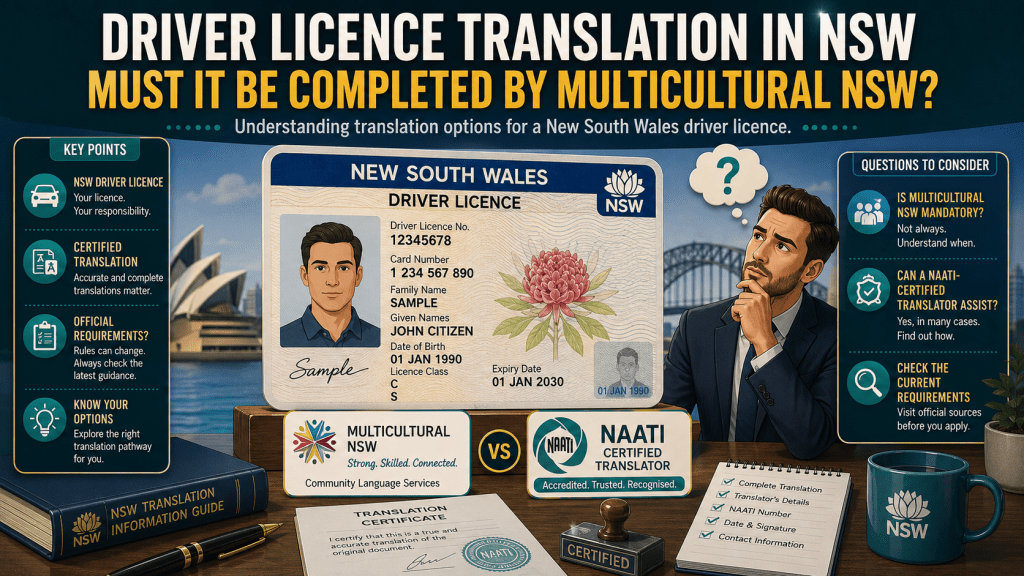
If you are planning to drive in New South Wales with an overseas driver licence, the translation requirements can be confusing. Many people assume that a NAATI-certified translation will automatically be accepted in every situation, but in NSW the rules can depend on why you need the translation.
There is an important difference between:
- carrying a translation so you can drive temporarily in NSW; and
- providing a translation when applying to transfer or convert your overseas licence to a NSW licence.
Understanding this difference can save you time, money and unnecessary stress.
The 6-Month Rule for Temporary Overseas Visitors
For temporary overseas visitors who arrived in NSW after 1 July 2023, Service NSW states that you may drive on your existing overseas licence for up to 6 months. If you wish to continue driving after that period, you need to apply for a temporary NSW licence.
This rule is particularly relevant if you are an international student, temporary worker, partner visa applicant or long-term visitor staying in NSW for more than 6 months.
What About Permanent Residents or Australian Citizens?
The 6-month rule mainly applies to temporary overseas visitors.
If you are an Australian citizen or permanent resident, you generally need to transfer your overseas licence to a NSW licence within 3 months if you wish to continue driving in NSW.
This is why it is important not to rely on general advice from other Australian states or territories. NSW has its own rules, and the relevant time limit may depend on your visa or residency status.
Applying for a NSW Licence: Translation Rules Are Stricter
The situation becomes more specific when you are applying to transfer an overseas licence or apply for a NSW temporary visitor licence.
According to Service NSW, where a licence or supporting letter is not in English, Transport for NSW only accepts translations from certain sources, including Multicultural NSW, the Department of Home Affairs, the Consulate-General of the Republic of Korea for Korean licences, and the Taipei Economic and Cultural Office for Taiwanese licences.
NSW’s own guidance on preparing an overseas licence application also states that if the overseas licence or confirmation letter is not in English, an original translation is required, and photocopies of original translations are not accepted.
This is why overseas licence holders should be careful.
Service NSW May Assess Previously Translated Documents
I contacted Service NSW to clarify whether an overseas driver licence translation must be completed by Multicultural NSW or the Department of Home Affairs for the purpose of converting to a NSW driver licence.
Their response was that if the licence has already been translated into English, the applicant may submit that translation to Service NSW. Service NSW will then assess whether the translation can be verified. If it can be verified, a further translation may not be required. If it cannot be verified, the applicant may be asked to obtain a new translation through an accepted provider, such as Multicultural NSW or the Department of Home Affairs.
In practical terms, this suggests that a current NAATI-certified translation with a verifiable digital stamp and QR code may assist with acceptance, although Service NSW still has the final decision. I have also received similar feedback from translators working in other languages, where their NAATI-certified driver licence translations were accepted by Service NSW for licence conversion purposes.
Because this is not stated in exactly the same way on the Service NSW website, applicants should still check directly with Service NSW before relying on a previously translated document.
Do You Need a NAATI-Certified Translation?
A NAATI-certified translation is widely used in Australia for official documents, including driver licences. However, NSW has its own administrative requirements for licence transfer purposes.
If you are only arranging a translation so that you can carry an English version of your overseas licence while driving temporarily, a NAATI-certified translation is suitable.
However, if your purpose is to transfer or convert your overseas licence to a NSW licence, you should check the current requirements with Service NSW or Transport for NSW before ordering the translation. This is especially important if you are planning to live, study or work in NSW for more than six months.
Digital Translation or Printed Original?
Many government departments now accept digitally issued NAATI-certified translations, especially where the translation includes a current NAATI digital stamp and QR code. However, for NSW licence matters, it is safer to check whether Service NSW requires a printed original translation.
If you are ordering a driver licence translation, it may be worth asking the translator whether they can provide:
- a digitally certified PDF translation; and
- a printed original copy if required.
This is particularly important because NSW guidance refers to an “original translation” for overseas licence applications.
Check the Translator’s Current NAATI Status
Before ordering a translation, make sure the translator is currently listed on the NAATI database and can issue a current NAATI-certified translation.
This matters because some older translators may still be known as former NAATI-accredited translators, but they may not be part of the current certification system or may not be able to issue a current NAATI digital stamp with a QR code. If the authority needs to verify the translation, an outdated credential or unverifiable stamp may cause delays or rejection.
Practical Tips Before You Translate Your Overseas Licence
Before arranging your NSW driver licence translation, consider the following:
First, confirm your purpose. Are you using the translation to drive temporarily, or are you applying for a NSW licence?
Second, check the current Service NSW requirements, especially if you are applying to transfer or convert your licence.
Third, confirm whether you need a printed original translation or whether a digitally certified translation is enough.
Fourth, make sure your translator is currently NAATI-certified and verifiable through the NAATI database.
Finally, keep a copy of all documents you submit, including the original overseas licence, the translation, and any confirmation from Service NSW.
Final Thought
NSW driver licence translation requirements can be more complicated than they first appear. A translation that is acceptable for one purpose may not be accepted for another.
If you are moving to NSW, studying in NSW, working in NSW, or staying for more than six months, it is better to check the translation requirements before placing your order. This helps you avoid paying twice for the same document and reduces the risk of delays when applying for your NSW licence.
For overseas licence holders, especially those with Taiwanese, Korean, Chinese or other non-English licences, getting the translation right from the beginning is an important step in driving legally and confidently in New South Wales.