
Why Court Interpreting Is a Unique but Challenging Environment
Many interpreters see court interpreting as a unique professional opportunity. It places you inside a highly structured legal environment, where every word matters and where the interpreter plays an essential role in helping parties participate meaningfully in the process.
At the same time, the courtroom can be daunting. The setting is formal, the pace can be unpredictable, and the pressure on accuracy, professionalism and procedural awareness is high. It is therefore understandable that some interpreters choose not to accept court assignments.
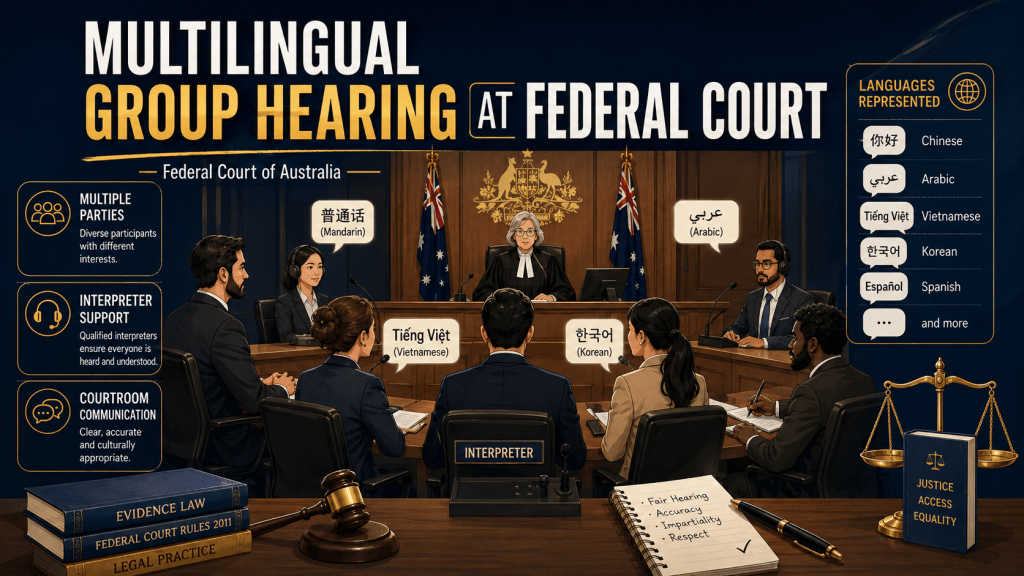
For those who do, however, court interpreting can be one of the most interesting and layered areas of practice. This is especially true in Federal Court migration matters, where directions hearings may involve several applicants, several languages, remote appearances, and multiple interpreters working in the same virtual or physical courtroom.
What Happens in a Federal Court Directions Hearing?
In Federal Court migration matters, a directions hearing is often held at an early stage of the case. Sometimes it is the first hearing; sometimes it takes place after some preliminary steps have already occurred.
The hearing is usually conducted by a Registrar. The purpose is often administrative and procedural. The Registrar may check whether the applicant wishes to continue with the application, whether documents have been received, whether written submissions or affidavits are required, and what orders should be made for the next stage.
The respondent in migration matters is usually represented by the Minister’s lawyer. The next stage may involve a more substantive hearing, where the parties may need to file written submissions and, in some cases, present oral argument.
When there is only one language involved, the interpreting arrangement can be relatively straightforward. For example, one Mandarin interpreter may interpret between the applicant and the court. The interpreter renders the applicant’s Mandarin into English and interprets the court’s English into Mandarin.
However, once several language groups are involved, the hearing becomes more complex. It is not exactly relay interpreting, but it can feel close to it. Several interpreters may need to wait, listen, monitor the flow of the hearing, and step in at the right time for their language group.
The Key to a Smooth Multilingual Hearing: Clear Allocation
From experience, the most successful multilingual hearings are usually those where the Associate, Court Officer or court staff have experience dealing with multiple interpreters.
Clear instructions make a significant difference. It helps when the Associate or Court Officer explains exactly when each interpreter is required, when they should interpret, and when they may stand by.
For example, if the court wants the opening announcement interpreted into several languages, the process runs much more smoothly when the order is made clear in advance:
| Step | Example Instruction |
|---|---|
| 1 | Mandarin interpreter to interpret first |
| 2 | Cantonese interpreter to follow |
| 3 | Vietnamese interpreter to interpret after that |
| 4 | Other interpreters to remain on standby until called |
This may seem simple, but it prevents confusion, overlapping voices and uncertainty. It also gives the applicants a clearer understanding of what is happening in the hearing.
A well-managed check-in stage can set the tone for the entire hearing.
Interpreters Should Clarify Video or Audio Appearance Requirements
Another practical issue is whether interpreters are required to appear by video or whether audio appearance is sufficient.
If this has not been made clear during the check-in stage, it is often wise for the first interpreter to clarify this with the Associate or Court Officer.
Once one interpreter confirms the expected mode of appearance, other interpreters usually follow the same approach. This saves time and creates consistency across the hearing.
In a courtroom, consistency matters. The Registrar knows what to expect, the applicants know what to expect, and the interpreters can follow the same procedure without unnecessary disruption.
Timing Can Become a Major Issue in Multilingual Directions Hearings
Directions hearings are often expected to be short and straightforward. In practice, however, multilingual hearings can take longer than anticipated.
Even the check-in process can consume a significant amount of time. Confirming file numbers, pseudonyms and applicant details across several language groups may take much longer than expected.
This can create a problem for interpreters who are booked for a short period. For example, an interpreter may be booked for one hour, but the first 50 minutes may be taken up by check-in and procedural matters before their language group is even reached.
The result is that interpreters may need to alert the court that their booked time is nearly finished. This can happen while the Registrar is still dealing with another language group.
Why Interpreters Should Monitor Time Carefully
Interpreters should not simply wait silently until the last minute and then announce that they must leave. While it may not be the interpreter’s fault that the hearing is running late, an unexpected departure can create serious practical difficulties for the court.
If an interpreter needs to leave soon, it is better to raise the issue early with the Associate or Court Officer.
For example:
| Situation | Better Practice |
|---|---|
| Check-in is taking much longer than expected | Monitor the time and hearing progress |
| Only 30 minutes remain in the booking | Alert the Associate or Court Officer early |
| Another hearing or booking follows | Tell the court before it becomes urgent |
| Your language group has not yet been reached | Give the court time to re-prioritise or adjourn if necessary |
This gives the Registrar an opportunity to manage the hearing. The court may decide to deal with that language group first, ask whether the interpreter can stay longer, or adjourn the matter so that an interpreter can be arranged for another time.
The important point is this: when you are booked as a court interpreter, your role is not limited to speaking only when it is your turn. You are part of the hearing process. You need to remain alert, monitor progress and help the hearing run as smoothly as possible.
Professional Dress Still Matters in Virtual Hearings
One issue that deserves more attention is dress code.
Some interpreters may think that because they are appearing remotely from home, they do not need to dress as they would for a physical courtroom. This is a mistake.
When you join a virtual hearing room, you are still appearing in court. A remote appearance is still a court appearance.
Your dress standard should reflect the seriousness of the setting. Lawyers do not appear in court in casual T-shirts, hoodies or caps. Interpreters should also be mindful of how they present themselves.
This is not only about personal image. It affects how the profession is perceived.
Why Interpreter Presentation Affects the Whole Profession
Professional appearance may not directly affect linguistic accuracy, but it does affect credibility.
When an interpreter appears in court wearing overly casual clothing, especially in a formal legal setting, it can reflect poorly not only on that individual interpreter but also on the broader interpreting profession.
Court interpreters work alongside Registrars, Judges, lawyers, court staff and applicants. Their conduct, presentation and communication all contribute to the court’s perception of interpreters as professionals.
This is especially important when interpreters are booked through language service providers that hold government contracts or standing offer arrangements. The interpreter is not only representing themselves; they are also representing the profession and, indirectly, other interpreters working in the same field.
Practical Takeaways for Court Interpreters
Multilingual Federal Court hearings can be complex, but they can run smoothly when everyone understands their role.
For interpreters, the key lessons are:
| Area | Practical Reminder |
|---|---|
| Check-in | Listen carefully and clarify your role early |
| Language order | Follow the Associate’s or Court Officer’s instructions |
| Video/audio appearance | Clarify expectations if they are not stated |
| Time management | Monitor your booking time and alert the court early |
| Professional conduct | Treat virtual hearings as real court appearances |
| Dress code | Dress as you would for an in-person courtroom |
Final Thoughts: Court Interpreting Is More Than Language
Court interpreting is not just about converting words from one language into another. It also requires procedural awareness, professional judgement, courtroom etiquette and respect for the legal setting.
In multilingual Federal Court migration matters, interpreters play a crucial role in ensuring that applicants are linguistically present and able to understand what is happening in their case.
A good interpreter is accurate. A professional court interpreter is also prepared, observant, punctual, appropriately dressed, and aware of the courtroom environment.
These details matter. They help the court, assist the parties, and strengthen the professional image of interpreters in Australia’s legal system.